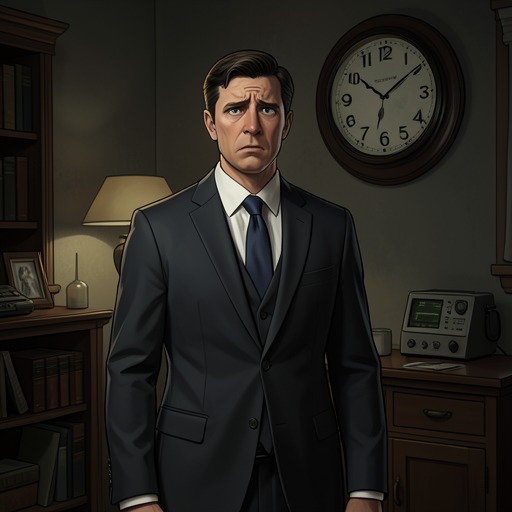
The ransom deal for Fran’s release
Panic RoomThe ransom deal for Fran Revell’s release converts her captivity into a tightly staged financial exchange: Jack Harkness offers five million Swiss francs, while Don Challenor persuades Amos French to accept the money in two instalments and secure Gennady Zlenko’s cooperation. The bargain changes Fran’s immediate condition from captive to free, but it is also designed to buy an end to the search for money Harkness is supposedly hiding.
The offer and its terms
The negotiation begins at night inside a stationary car, its engine and lights switched off. In that darkness, Don asks what he is supposed to say if French answers his call. Harkness instructs him to claim that he has the full details French wants: the location of the money French has been paid to find. Don objects that he has no such information. The plan does not depend on that claim being true. Harkness intends to equip him with a more immediate inducement: half the cash in a bag on the back seat, which he expects will persuade French to end the search and release Fran.
The amount is five million Swiss francs. Harkness explains that Swiss high-denomination banknotes make the sum compact enough to carry in the bag. He frames the proposal as a direct payoff: French gets money, Fran gets out, and Don benefits as well. When Don questions whether he is serious, Harkness insists that he can afford it. The money therefore serves two purposes in the scene: it is ransom for Fran and leverage against French’s continued pursuit of the alleged hidden funds.
Harkness gives Don a precise offer to make. Don is to meet French at Lizard Point car park at eight the following morning and offer him two and a half million Swiss francs immediately, with another two and a half million when Fran is released. Harkness will wait near Chybargos, ready to deliver the second instalment once French agrees and gives Zlenko, whom he expects to have left guarding Fran, the signal to let her go. The payment is conditional on French and Zlenko stopping their search for the money Harkness is supposedly accused of stealing.
French accepts the bargain
The proposed deal asks French to exchange his expected share of the money for a different reward: Harkness predicts that French will value a testimonial from Quintagler Industries, while Zlenko’s share would, in Harkness’s sardonic calculation, keep him supplied with vodka for life. These terms show that the offer is not merely a cash handover. Harkness is betting that both men can be persuaded by rewards tailored to their separate interests, even as the larger purpose is to close the search.
French initially resists Don’s offer by invoking their prior agreement. He says Fran’s release was supposed to be exchanged for full particulars about where Harkness had stashed the cash, an amount he insists is worth much more than a few million Swiss francs. Don counters that the money on offer would belong to French to bank and spend without questions, and that it exceeds the commission French is earning from Quintagler. The discussion brings the difference between the old and new bargains into focus: French had expected information leading to a larger sum, but Don offers cash he can receive directly.
Don tells French that he can count the money in his presence. French eventually accepts, though his tone is described as regretful and resigned, and Don makes clear that Zlenko must also be brought into the agreement. That requirement matters to the exchange’s mechanics: French’s acceptance alone cannot free Fran while Zlenko remains the guard. The negotiation has secured the first agreement, but release still depends on the second man’s participation and on the promised cash being delivered.
Fran’s release
At the place where Fran has been held, the arrival of a car prompts her to listen for the person speaking outside. She recognizes Harkness’s voice. Several minutes later, Zlenko enters, unlocks her handcuffs, and helps her out of the chair with an oddly formal courtesy. His announcement that it is time to go marks the change from confinement to release before Fran has yet seen the terms of the deal fulfilled.
In the yard, Harkness is waiting beside a bright red Mercedes convertible that Fran believes belongs to Mike Coleman. He carries a canvas holdall and apologizes for what she has endured on his account. Zlenko now holds Fran lightly by the elbow, a gesture that accompanies his changed role from captor to escort. Harkness tells her that they have made a deal and that she is free. Zlenko takes the bag from him; Fran glimpses bundles of cash inside and understands that Harkness has paid for her release.
Harkness tells Fran that the key is in the car’s ignition and that she can drive wherever she likes. He urges her to leave without delay, but asks her not to contact anyone yet: French will give Don her phone after he and Harkness have finished. He explains that Don is on his way with French and directs her to meet him at Robin Pawley’s offices in Helston at noon, when the men should have gone their separate ways. The arrangement frees Fran while keeping the immediate movements of the people involved under control.
Consequences and significance
Fran asks whether she is really free, and Harkness confirms that she is. She drives out of the yard and, within seconds, the place where she has spent the previous two days disappears from view. The release completes the exchange’s most urgent purpose: the captivity ends, and Fran is no longer under Zlenko’s restraint. Her departure is presented through concrete changes in access and movement—the unlocked handcuffs, the car key, the open road—rather than through any account of what the captors may later do.
The deal also leaves Don as the intermediary who has secured French’s agreement, while Harkness remains responsible for the money and the second instalment. Its apparent success rests on a calculated substitution: instead of providing the demanded location of the hidden funds, Harkness offers a large, portable sum and conditions its payment on Fran’s release and the end of the search. The scene thus resolves the immediate hostage crisis through negotiation, but its terms keep the alleged theft and the money hunt in play. Freedom is obtained, yet it is bought within a bargain designed to manage several risks at once.